Blogs

TPMinds International 2026: Five Strategic Shifts in Transfer Pricing

Transfer pricing has shifted from a compliance checkbox to a core business function. At TPMinds International 2026, industry leaders highlighted five critical trends that are reshaping how organizations approach transfer pricing in 2026 and beyond.

Blogs

TPMinds International 2026: Five Strategic Shifts in Transfer Pricing

Transfer pricing has shifted from a compliance checkbox to a core business function. At TPMinds International 2026, industry leaders highlighted five critical trends that are reshaping how organizations approach transfer pricing in 2026 and beyond.

Blogs

TPMinds International 2026: Five Strategic Shifts in Transfer Pricing

Transfer pricing has shifted from a compliance checkbox to a core business function. At TPMinds International 2026, industry leaders highlighted five critical trends that are reshaping how organizations approach transfer pricing in 2026 and beyond.

Blogs

TPMinds International 2026: Five Strategic Shifts in Transfer Pricing

Transfer pricing has shifted from a compliance checkbox to a core business function. At TPMinds International 2026, industry leaders highlighted five critical trends that are reshaping how organizations approach transfer pricing in 2026 and beyond.

Blogs

TPMinds International 2026: Five Strategic Shifts in Transfer Pricing

Transfer pricing has shifted from a compliance checkbox to a core business function. At TPMinds International 2026, industry leaders highlighted five critical trends that are reshaping how organizations approach transfer pricing in 2026 and beyond.

Why you should download

Why you should watch

TPMinds International 2026: Five Strategic Shifts in Transfer Pricing

June 25, 2026
Transfer pricing has shifted from a compliance checkbox to a core business function. At TPMinds International 2026, industry leaders highlighted five critical trends that are reshaping how organizations approach transfer pricing in 2026 and beyond.

TPMinds International 2026 brought together tax authorities, policymakers, in-house tax leaders and advisors from around the world to discuss the issues shaping the future of transfer pricing.

The two days of discussion showed how transfer pricing is becoming increasingly interconnected with broader business strategy, technology, governance and global policy developments.

Below are the five themes that stood out most strongly.

1. Transfer Pricing Is Becoming a Strategic Business Function

Historically, transfer pricing was often viewed as a compliance requirement focused on documentation and defending tax positions, but that mindset is rapidly changing.

Throughout the conference, speakers highlighted how transfer pricing now sits at the center of major business decisions, including supply chain transformation, operating model design, customs planning, global mobility, business restructuring and geopolitical risk management.

The challenge facing organizations is no longer simply maintaining compliance but ensuring that transfer pricing outcomes align with how value is genuinely created across the organization.

2. AI Is Transitioning from Concept to Practical Tool

Artificial intelligence dominated discussions throughout TPMinds, but the focus has shifted decisively from theory to practice. Organizations are already deploying AI across the transfer pricing function: automating benchmarking exercises, preparing contemporaneous documentation, reviewing intercompany agreements, monitoring operational outcomes, and flagging audit risks in real time.

One particularly interesting example involved the use of multi-agent AI workflows capable of reviewing legal, transfer pricing, VAT, and withholding tax implications simultaneously before producing draft agreements.

However, speakers were unanimous on one point: AI enhances expertise but does not replace it. Data quality, governance, and human oversight remain fundamental to successful implementation.

3. Pillar Two Has Become an Operational Challenge

While Pillar Two dominated policy discussions in recent years, TPMinds highlighted how attention has now shifted towards implementation.

Businesses shared experiences of redesigning reporting processes, adapting ERP systems, building data collection frameworks, and preparing for ongoing compliance obligations.

A recurring theme was the scale of effort required relative to the tax outcomes generated. Many organizations reported significant compliance work even in situations where no top-up tax liability ultimately arises.

As Pillar Two continues to mature, businesses are increasingly calling for greater simplification, standardization and consistency across jurisdictions.

4. Tax Certainty Is Increasing in Importance

A notable shift across many sessions was the growing emphasis on certainty. As audit activity increases and international tax rules continue to evolve, organizations are investing more heavily in dispute prevention and risk management strategies.

Discussions around APAs, MAPs and controversy management reflected the common goal to reduce uncertainty and mitigate double taxation.

Several speakers also stressed the importance of preparing for disputes long before they arise. Strong governance, contemporaneous evidence, and audit-ready documentation are becoming essential components of effective transfer pricing management.

5. Transparency Is Reshaping Expectations

The rise of public Country-by-Country Reporting and broader tax transparency initiatives is changing how organizations communicate tax information.

Investors, regulators and other stakeholders increasingly expect businesses to explain not only where tax is paid, but also how value is created and how tax outcomes align with commercial activity.

A particularly interesting theme was the growing overlap between tax, ESG reporting, investor relations, and corporate governance. Tax transparency is no longer viewed as a standalone compliance issue but as part of a wider stakeholder communication strategy.

Looking Ahead

Perhaps the most important conclusion from TPMinds International 2026 is that transfer pricing is no longer operating in isolation.

Technology, geopolitics, supply chain disruption, transparency requirements, global mobility and international tax reform are increasingly influencing transfer pricing outcomes.

For businesses, success will depend on more than technical compliance. It will require strong data foundations, effective technology adoption, proactive risk management, and close collaboration across tax, finance, legal and operational teams.

As the global tax landscape continues to evolve, the organizations that can combine technical excellence with strategic agility will be best positioned to navigate the challenges ahead.

Meet the authors

Transform your approach to transfer pricing now

Cancel anytime. Backed by TP experts.
7-day free trial
Set up instantly
Up-to-date, accurate answers
REPORTS

TPMinds International 2026: Five Strategic Shifts in Transfer Pricing

Transfer pricing has shifted from a compliance checkbox to a core business function. At TPMinds International 2026, industry leaders highlighted five critical trends that are reshaping how organizations approach transfer pricing in 2026 and beyond.

Hereʼs Why You Should Get the Report

0

See how peers are adapting to global change

Understand how 140+ MNEs and advisory firms are responding to shifting regulations, heightened audit scrutiny, and technology-driven change, and where your approach stands in comparison.

0

Learn how others are driving compliance

Explore the approaches to resourcing, data management, and operational transfer pricing that teams are using to tackle growing workloads.

0

Identify emerging trends shaping the profession

Gain insight into how AI, automation, and operating models are redefining transfer pricing, so you can plan for the skills, tools, and processes youʼll need next.

Insights

What youʼll learn inside the Aibidia report 2025

The rising cost of tax scrutiny
01

The rising cost of tax scrutiny

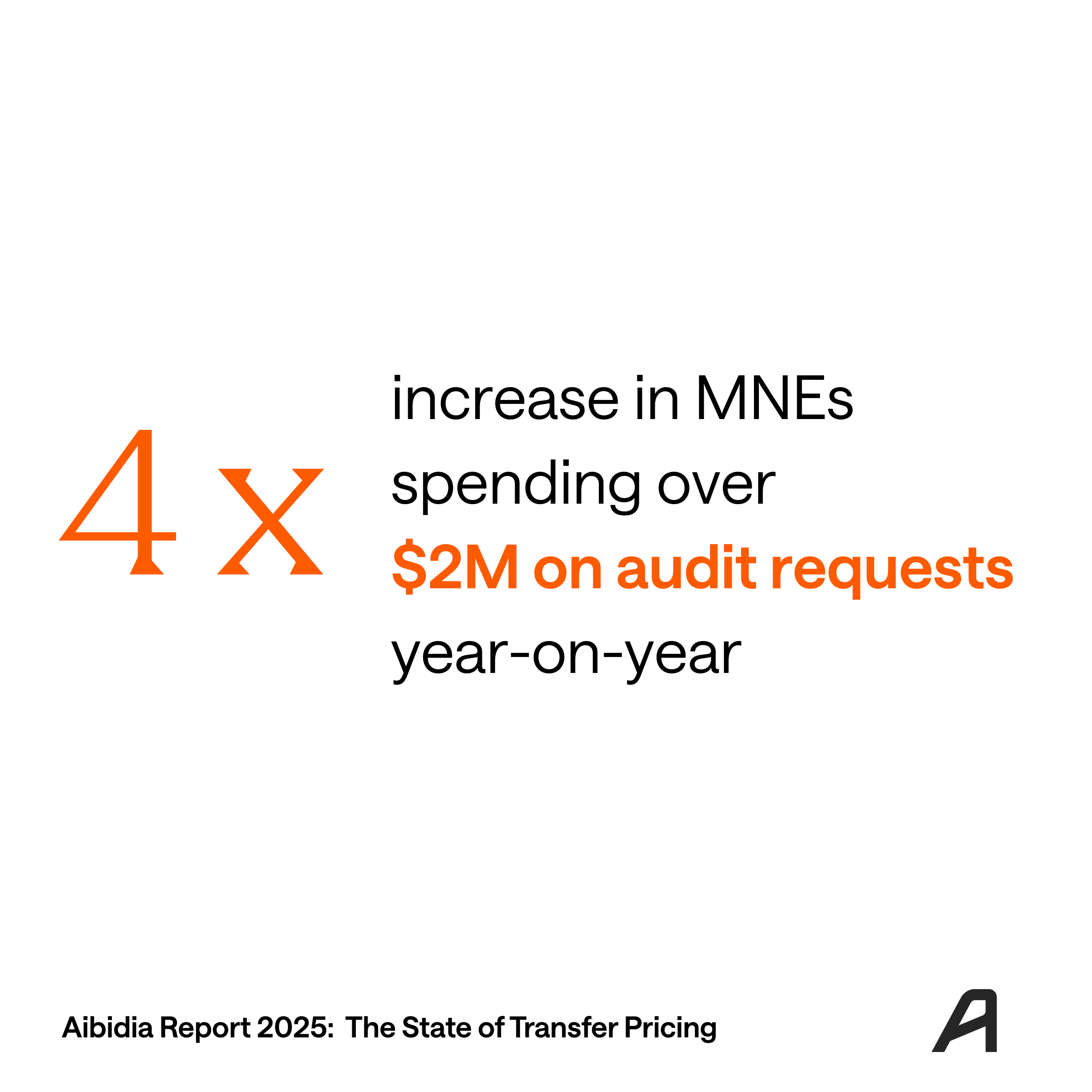
Heightened tax authority demands are driving up the time and money TP teams spend on audits. Companies with stronger documentation processes, centralised data, and proactive OTP practices are better positioned to contain both costs and risk.

02

The state of OTP maturity

Only 35% of companies have a well-defined OTP process, while 24% have none at all. Barriers to OTP maturity include poor data access, complex business models, and limited coordination between tax, finance, and IT.

03

The importance of structured data

With 72% of companies in fragmented data environments, the report shows how centralised data helps TP teams insource more processes, ensure consistent compliance, and handle audits more efficiently.

04

Technology and AI adoption in practice

42% of MNEs are investing in specialist software, reducing reliance on traditional tools. AI interest is steady rather than explosive, hinting that TP teams need clean, structured data before advanced analytics can add value.

Download the report

Submit the form below to access your report.

By submitting this form, I confirm that I have read the Privacy Policy and agree to the processing of my personal data by Aibidia for the stated purposes.
Thank you! The report will be sent to your inbox.

Expert insights

Structured, reliable data is essential for executing a consistent, defensible transfer pricing strategy. Common barriers to structured data include siloed legacy source systems, unclear data ownership, and inconsistent definitions across entities and functions.

Prasad Parwidala
Head of Professional Services, Aibidia
Read the case study

We see significant variation in OTP maturity across companies. In many cases, if existing processes appear to work, there’s less motivation to change. However, where we see this changing, is within MNEs that have faced increased scrutiny or operate with more complex structures.

Pia Honkala
Global Commercial Head - Operational Transfer Pricing, Aibidia
Read the case study

While there are many challenges in accessing the right data for TP calculations and analysis, one of the most significant barriers to OTP adoption can be the misalignment of KPIs between Finance and Tax teams.

Marlon Manto
Director, Transfer Pricing Advisory, Aibidia
Read the case study

We’re seeing practical AI adoption in areas such as navigating country-specific documentation requirements, researching transfer pricing methods, comparing jurisdictional rules, and tracking global compliance timelines.

Maria Helander
VP Product, Aibidia
Read the case study