

Most transfer pricing professionals have by now formed an opinion on AI, even if they have not yet formed a strategy. Some are experimenting with research tools and document drafting. Others are waiting for the technology to mature. A smaller group is already rethinking entire workflows. What separates these camps is less access to technology than clarity about where AI genuinely helps, where it still falls short, and where the most significant opportunities are heading next.
The State of Play: Still Early, But Accelerating
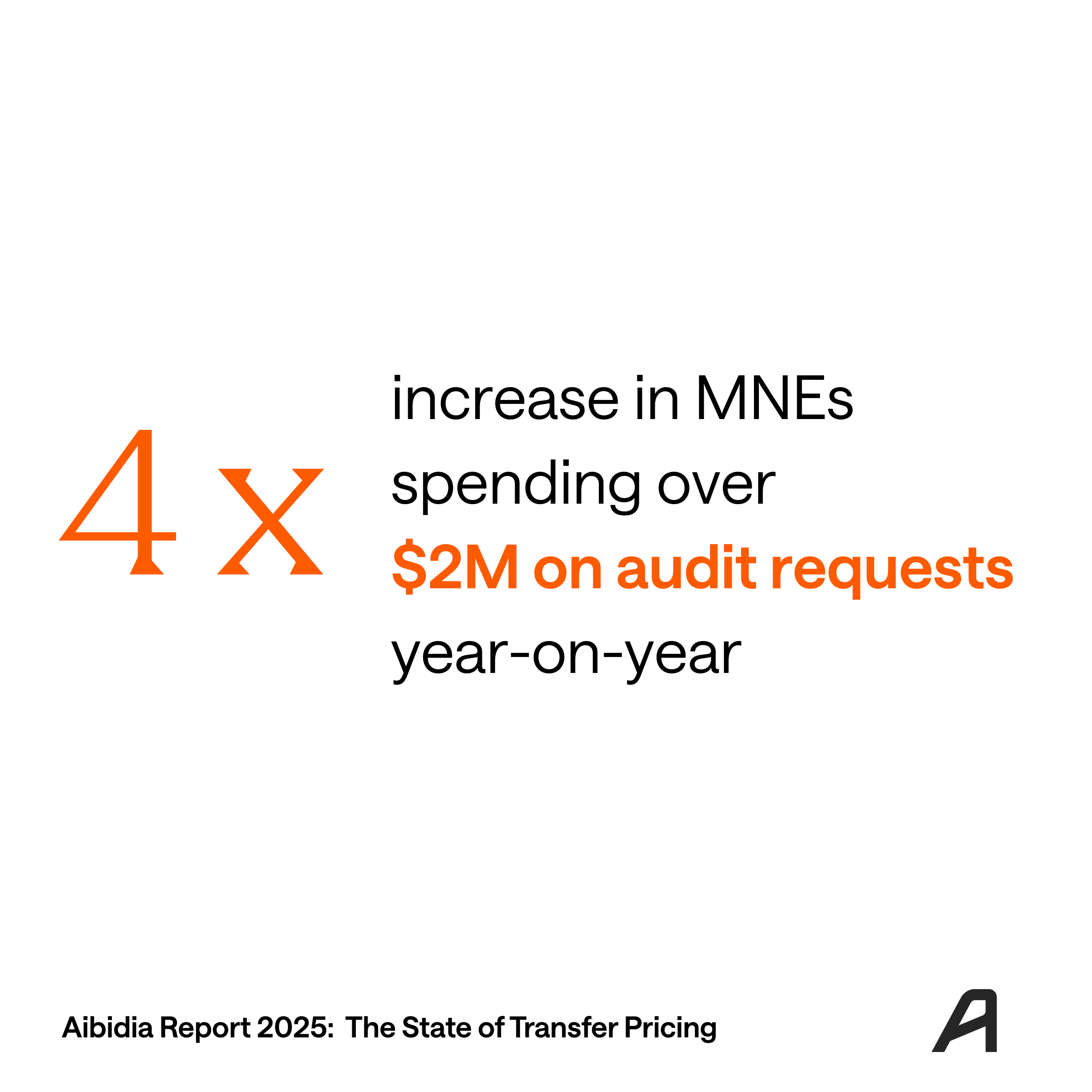
The latest edition of Aibidia's annual industry report, "The State of Transfer Pricing," drawing on insights from more than 140 multinationals and transfer pricing professionals, revealed a familiar picture. Fragmented data and data quality challenges remain top of mind, while adoption of dedicated TP software has nearly doubled: a clear signal that the market is actively seeking solutions, not just talking about them.
On AI specifically, roughly 40% of respondents described their usage as minimal. But the trend line is unmistakably upward. As Tom Nuorivaara, who works directly with clients navigating these decisions, put it:
"Most TP teams are still exploring. They're in the phase where they're trying to find the right tooling, the right processes and the right ways to utilize AI in transfer pricing."
That exploration phase, however, is already producing tangible results.
What AI Is Actually Good At (Right Now)
Several concrete use cases have emerged where AI is already earning its keep in transfer pricing functions.
Research and staying current. Tax and transfer pricing are among the most dynamic fields in professional services. Regulations shift, guidelines evolve, and case law emerges constantly. For central TP teams managing dozens of jurisdictions (and for local subsidiaries who touch transfer pricing perhaps once a year) keeping pace is exhausting. Bas van Houts described the immediate practical value:
"Having a tool where you can just quickly go in to check certain definitions, check deadlines, check local requirements… That is going to be very, very useful."
This is the accessible "low-hanging fruit" that Luis Nouel also highlighted: AI as an always-on research assistant that brings every user up to speed instantly, without burdening the central team.
Documentation and narrative drafting. If there is one area where AI is already meaningfully transforming the workload, it is transfer pricing documentation. The workflow is straightforward: the professional provides the facts and context, the AI drafts the narrative, and the expert reviews, edits, and approves. For local files, entity descriptions, and master file content, this model is already being put into practice. Luis captured his reaction when he first encountered large language models:
"The first time I played with one of the LLMs and I saw how wonderful they manage things and create convincing stories, I said: this is going to be amazing for transfer pricing documentation."
Comparable searches and benchmarking. What currently takes hours (sometimes days) of database searching could be dramatically compressed. Luis pointed to comparable searches as one of the clearest near-term wins:
"AI is going to have a major impact... at least the initial search for comparables is going to really be sped up."
The nuance matters here. AI accelerates the search and surfaces candidates; the professional still applies judgment to select and refine. As Luis framed it, "the strength of the AI is data, the strength of the transfer pricing and tax professional is judgment."
Acting as a sparring partner for non-specialists. One underappreciated use case involves the local finance or tax contact who deals with transfer pricing infrequently. AI can serve as "a little bit of a sparring partner," as Tom put it, for someone updating an entity description who lacks the broader context of what TP documentation requires. Give it the facts; let it formulate a compliant draft; have the expert sign off.
The Challenges Are Real
Intellectual honesty about the obstacles is just as important as the optimism.
Data quality is make-or-break. Fragmented, poorly standardized data is not an AI problem. It is a business problem that predates AI and will persist regardless. Bas was direct:
"If you have very fragmented data or a lot of stuff is done manually at the moment, I would say you first have to make sure that your data is much more standardized before you can make the step to AI."
Luis framed it simply: "Garbage in, garbage out." The good news is that data standardization is a worthwhile investment on its own terms. It improves manual processes and positions the organization well for AI when the time comes.
Hallucinations and defensibility require human oversight. In transfer pricing, the stakes of an AI error are particularly high since documentation forms the basis of an audit defence. General-purpose LLMs can produce outputs that look authoritative but lack clear sourcing. As Tom noted:
"You can't just blindly trust it, you need to have traceability and some kind of transparency of why it is coming up with the outcome that it is."
This is why the concept of what Luis called the "human oversight architecture" is so important: a clear sign-off structure, with an accountable professional validating every AI output before it becomes part of the record.
LLMs and numbers don't mix well. An important technical caveat for anyone planning to use AI for calculations or margin monitoring: large language models are built for language, not arithmetic. Tom was clear:
"LLMs are very strong with language... they're not so good with numbers. So you typically need to have some calculation underneath that the LLM can orchestrate."
Machine learning models, by contrast, are well-suited to numerical tasks like forecasting. The practical implication is to understand which type of AI fits which task, and build accordingly.
The Tax Authorities Are Already There
The case for urgency becomes harder to dismiss when you consider what is already happening on the other side of the table. As Luis noted:
"Tax authorities have been using AI already for eight years. They're implementing tools, but they're doing it quietly."
For transfer pricing professionals wondering whether AI adoption is premature, this reframes the calculation entirely. If revenue authorities are already using AI to analyse submissions, identify discrepancies, and flag anomalies, the question is not whether to engage with AI, but how quickly professionals can develop equivalent capability.
Bas drew the practical conclusion directly:
"Tax authorities will use it to their advantage, and we need to do exactly the same. We need to be a step ahead. Better to start getting used to it ASAP."
AI Won't Replace You, But Someone Using AI Might
The "will AI take my job?" question is inevitable in any discussion like this. The answer, consistently, is that expert judgment is becoming more valuable rather than less, because someone needs to validate AI outputs, make the final call, and take accountability. Luis drew a useful historical comparison to the arrival of spreadsheets: when Lotus 1-2-3 appeared, accountants feared for their livelihoods. Instead, the function was transformed and empowered.
Tom put it in terms that cut to the heart of the matter:
"AI will not take your job, but someone using AI might be taking your job."
Those who build fluency with these tools will simply operate at a different level of efficiency than those who do not.
Four Pillars for Readiness
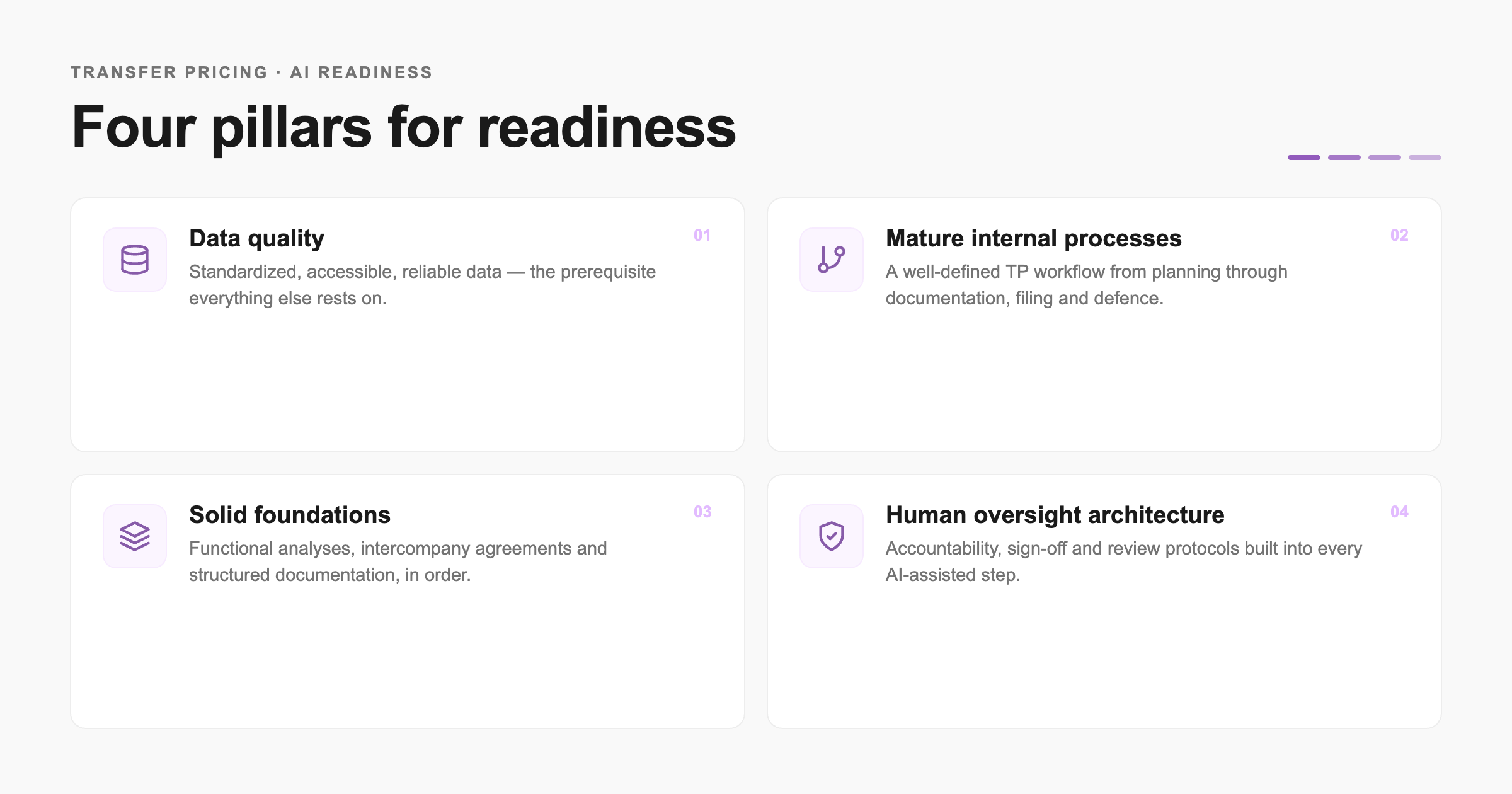
For organizations assessing where they stand, Luis offered a useful framework organized around four pillars:
- Data quality: the foundation. Standardized, accessible, reliable data is a prerequisite.
- Mature internal processes: a well-defined TP workflow from planning through documentation, filing, and defence gives AI something meaningful to work with.
- Solid foundations: functional analyses, intercompany agreements, and structured documentation need to be in order before AI can add value on top.
- Human oversight architecture: clear accountability structures, sign-off processes, and review protocols built into every AI-assisted workflow.
Tom's advice for getting started was equally pragmatic:
"You probably won't build an end-to-end one-shot agent on the first go. You need to split it into different steps and different tasks, solve them individually, and then once you have the clear data, clear process, clear review structure, you can start to automate the steps in between."
The Right Mindset: Start Small, Think Big
The technical and operational groundwork matters, but it only gets an organization so far. Bas described how his own thinking evolved from viewing AI as a simple research tool to seeing potential applications across the entire TP lifecycle:
"The more you start to think about it, the more ideas come into your mind... you just see more and more business cases where you can use it. So it's just a matter of mindset."
Tom's closing analogy was apt: "How do you eat an elephant? One piece at a time. Start small, solve one problem first, then move on to the next one. In two years you will have your transfer pricing transformed."
And Luis returned to the theme of human oversight, not as a limitation, but as a professional differentiator:
"Whatever we implement needs to be vetted by a human person... it's not impossible, it's not difficult, it's going to empower your daily work."
The shift from hype to genuine utility in transfer pricing AI is underway. The professionals who engage with it now, critically, thoughtfully, and with appropriate oversight, will be the ones shaping what the function looks like in five years. The tax authorities, quietly, have already started.


.png)
.png)
.png)

.png)
.png)






.svg)

