
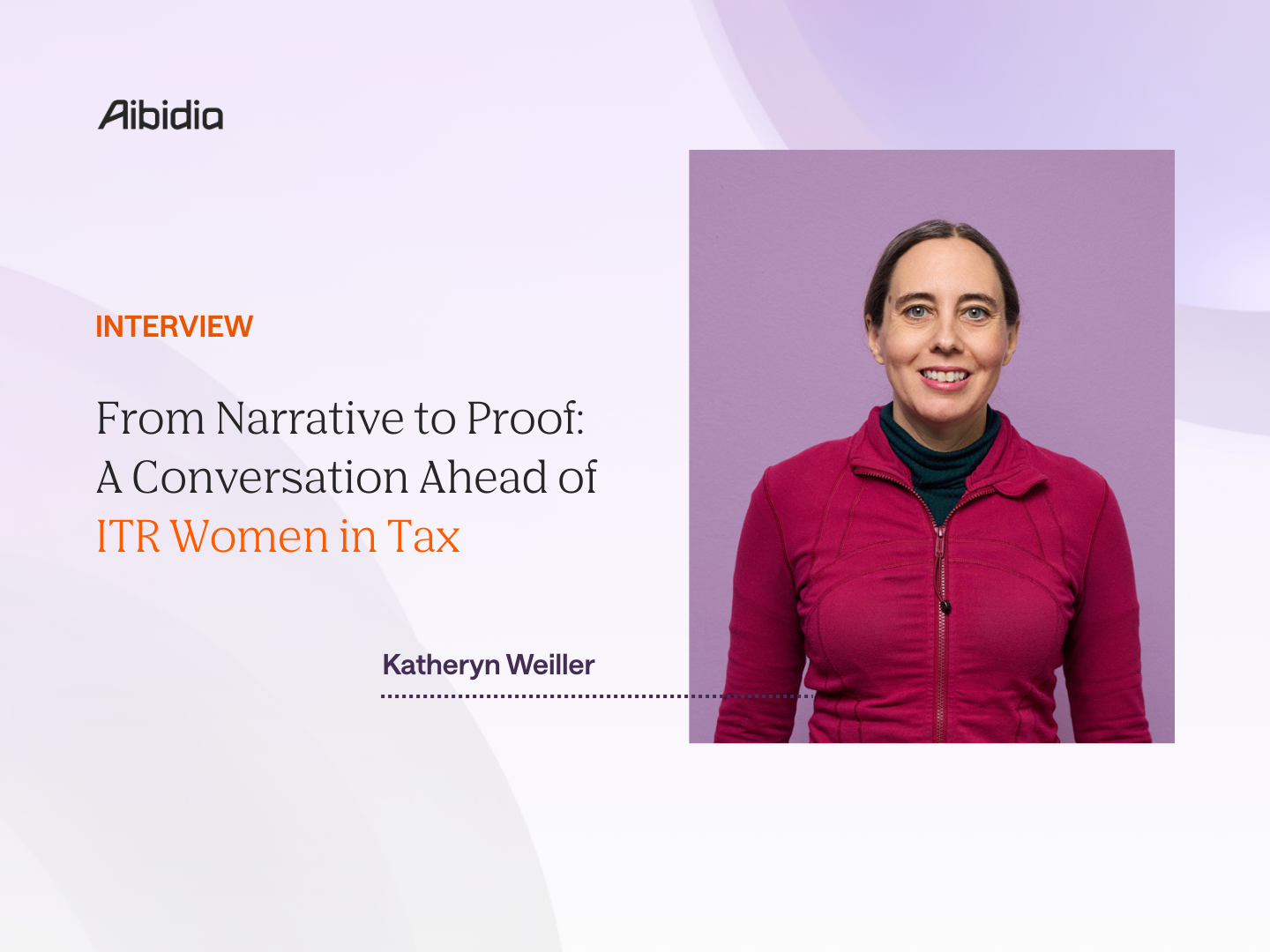
This week, our very own Katheryn Weiller will be speaking at the ITR Women in Tax conference in the US on the panel, “Global Tax Risk Management & Transfer Pricing – Documentation Strategies and Transparency Imperatives.”
It’s a timely topic. Transfer pricing documentation used to be about telling a coherent story. Today, it’s about proving that story with evidence.
Ahead of the event, we sat down with Katheryn to discuss how transfer pricing documentation is evolving, and what tax teams need to prioritize now.
.png)
Q: Why is this panel topic so timely right now?
Katheryn: Over the past few years, we’ve seen a real shift in how tax authorities approach transfer pricing documentation.
Ten or fifteen years ago, documentation focused heavily on building a strong narrative to support a policy choice. Today, narrative alone isn't enough on its own.
With the ability to gather increasing amounts of taxpayer data and increasingly sophisticated data analytics, tax authorities now have the ability to target audit subjects and test positions in a much more granular way. They’re asking for proof, not just explanation.
They want to see:
- That the financial data used to apply transfer pricing policies is correct, complete, and consistent
- That the people said to perform DEMPE functions are genuinely making key decisions
- That risk control is happening where the documentation says it is - not simply reflected in intercompany agreements
Documentation is no longer about telling the story. It’s about evidencing it.
Q: What does that mean in practice for in-house tax teams?
Katheryn: It means teams need to think beyond the core transfer pricing file.
One recommendation I often make is to build audit-ready files proactively, separate from standard documentation.
If the IRS or other authority come knocking with a 30-day IDR, you don’t want to be reconstructing history under pressure - particularly when audits may happen years down the road and people with institutional knowledge may have moved on.
Proactive files might include:
- Board or committee minutes documenting how key strategic decisions were made
- Org charts evidencing where key personnel sit
- Documentation of cross-functional decision-making processes
- Analyses supporting transfer pricing policies under alternate approaches, anticipating likely challenges from tax authorities
It's also important for in-house tax teams to understand how their organization is presented to the public - what is the story being told in the 10-K? On the website? In the press? Does that align with how value creation is described in the transfer pricing documentation?
The goal is to be strategic rather than reactive.
Q: So, are all transfer pricing positions equally exposed?
Katheryn: No, and that’s an important point.
Not every transaction requires the same level of evidentiary support. In-house tax teams are quite used to considering the riskiness of their positions - a risky position doesn't mean a taxpayer's position is wrong, it simply means it may attract closer scrutiny and involve larger potential adjustments.
Areas where we often see a lot of audit scrutiny include:
- Intangibles and DEMPE alignment
- Cross-border financial transactions
- Headquarters or centralized service charges
- High-value services that may give rise to embedded intangibles
Taking a risk-based approach allows teams to focus effort where it matters most.
It’s also important to note that being proactive doesn’t mean gathering every possible document or running every side analysis under the sun. It means understanding which facts are most critical to supporting the taxpayer’s position and ensuring you have evidence to support those facts.
It also requires taking an objective look at where the potential pressure points are in your analysis. Is your benchmark range supported by a few weaker comparables? Are there arguably comparable uncontrolled transactions when you’ve selected a profit-based method? If a tax authority challenges you on those points, do you know how you’ll respond?
Q: Back to what this means in practice - what’s the biggest blocker preventing in-house tax teams doing this today?
Katheryn: Capacity.
Most teams are stretched extremely thin. They’re managing compliance deadlines, ongoing audits in multiple countries, supply chain adjustments, and increasing regulatory data demands.
Finding time to proactively build robust documentation processes (while staying on top of everything else) is very difficult.
That’s why freeing up time for strategic thinking is so important. Monitoring compliance effectively throughout the year can prevent year-end scrambles and allow teams to focus on high-risk areas.
Q: What differentiates high-performing tax teams in this environment from your experience?
Katheryn: Three things stand out.
First, strong cross-functional relationships.
Transfer pricing depends on facts and circumstances. Those facts live across finance, operations, R&D, and leadership, among others. Tax needs to build close relationships throughout the organization to know what the current facts actually are - and how they may change, so Tax isn't always in a reactive mode.
Second, creating space for strategic thinking.
When teams aren’t constantly firefighting, they can focus on governance, defensibility and long-term risk management while still supporting broader business objectives.
Third, aligning strategy with operational reality.
Even the most sophisticated transfer pricing strategy falls apart if it can’t be implemented. Depending on the policy selected, you need to be able to segment P&L correctly, extract reliable data, and execute policies consistently.
Q: The conference is Women in Tax. Why does that matter?
Katheryn: The technical issues we discuss aren’t different for men and women, but career pathways have historically looked different.
At junior levels, the profession is fairly balanced. But representation drops significantly at senior manager, director, and partner levels. Today, the growth of in-house roles has created alternative leadership pathways, but visibility still matters.
Events like ITR Women in Tax create space for diverse voices and leadership styes and that benefits the entire profession.
It’s also important for organizations to view conference participation as a development opportunity. Speaking roles, panel participation, and thought leadership are part of how careers develop. Supporting next-level leaders in those opportunities strengthen the talent pipeline for everyone.
Q: Final thought - what do you hope attendees take away from the panel?
Katheryn: That documentation strategy is no longer a compliance exercise, intended to be filed away in a desk drawer and never looked at again.
It’s a core component of good corporate governance and increasingly, it's evidence.
The shift from narrative to evidence is only accelerating and teams that prepare proactively will be in a much stronger position when scrutiny comes knocking.
If you’re attending ITR Women in Tax Forum 2026, we look forward to seeing you there!


.png)
.png)

.png)

.png)
.png)






.svg)

