
Transfer pricing documentation is the set of reports and records a multinational group prepares to demonstrate that its intercompany transactions are priced at arm’s length, that is, on the terms independent parties would have agreed. Under the OECD’s three-tiered standard approach introduced by BEPS Action 13 (2015), it comprises a Master File, Local Files, and a Country-by-Country Report (CbCR). More than 100 jurisdictions have since incorporated some version of this standard approach into domestic law, though only its CbCR element is a BEPS minimum standard subject to peer review, and none of it is a directly binding international rule. It applies only once a jurisdiction adopts it into its own rules, and jurisdictions have done so in different ways.
What does the three-tiered approach include?
Master File. Describes the group as a whole: organizational structure, business lines, intangibles, intercompany financing, financial and tax positions, and overall transfer pricing policies. One Master File generally covers the entire group and is shared with every jurisdiction that requires it.
Local File. Covers a single entity in a single jurisdiction: its material intercompany transactions, the method applied to each, the functional analysis (functions performed, assets used, risks assumed), and the benchmarking supporting the arm's length outcome. A group with entities in 40 countries may need 40 or more Local Files, each conforming to local rules on language, format, and deadline.
Country-by-Country Report. Groups with consolidated revenue of EUR 750 million or more in the preceding fiscal year (or the local-currency equivalent each jurisdiction has set) file a CbCR. Some jurisdictions convert the euro figure on an ongoing basis; others, like the United States ($850 million under Treas. Reg. §1.6038-4), fixed a local-currency figure at adoption and have not rebased it since. The CbCR is a jurisdiction-by-jurisdiction breakdown of key items, including revenue, profit, tax paid and accrued, employees, and tangible assets. Of the three tiers, only the CbCR has a threshold set by the OECD; Master File and Local File thresholds are set locally and vary widely, from revenue-based tests to transaction-value tests to no threshold at all.
Is the three-tiered approach mandatory everywhere?
No. Because Action 13 is not a self-executing rule, each jurisdiction decides its own Master File and Local File thresholds, documentation formats, and whether it uses OECD terminology at all. The clearest divergence is the United States, which has no formal "Local File" requirement. Instead, penalty protection under IRC §6662(e) runs through Treas. Reg. §1.6662-6: taxpayers maintain "principal documents" that must be in existence when the return is filed and "background documents" supporting them. Principal documents must be produced within 30 days of an IRS request during an examination, and background documents within 30 days of any later request for them. The practical effect is similar to a Local File (functional analysis, method selection, benchmarking), but the legal mechanism is different: it is not a mandatory annual requirement but a defense a taxpayer chooses to build, with the return filing date and the 30-day production window doing the work that preparation and submission deadlines do elsewhere.
What does "contemporaneous" documentation mean?
Less literally than the term suggests. It does not mean documentation prepared at the moment of the transaction, but documentation that exists by a defined point, which varies by jurisdiction. Under the US framework described above, that point is the filing of the return. Several OECD-aligned jurisdictions take the same approach, requiring documentation to be ready by the tax return filing date rather than assembled in response to an audit letter. Others formally permit production within a fixed window, commonly 30 days, after a tax authority requests it, but documentation assembled only at that point may carry less weight than documentation prepared before any request, even where the local rule technically allows it. The distinction matters because, in jurisdictions that shift the burden of proof to the tax authority where adequate contemporaneous documentation exists, that benefit can depend on timely preparation, not just eventual production.
Why does documentation matter beyond the filing obligation itself?
Documentation is the first line of defense in an audit: when a tax authority questions an intercompany price, the Local File (or its jurisdictional equivalent) is what answers. Beyond that, four consequences can follow from getting it wrong:
- Penalties separate from any tax adjustment. Several jurisdictions penalize documentation failures on their own terms. Poland is a commonly cited example: individuals responsible for the entity's transfer pricing reporting, typically management board members, can face personal liability under the Fiscal Penal Code for documentation and reporting failures.
- Double taxation. Without documentation to support a position, a tax authority can more readily substitute its own pricing, and the same profit can end up taxed in two countries unless the other country grants a corresponding adjustment, usually through a mutual agreement procedure.
- Burden-of-proof protection forgone. In jurisdictions where contemporaneous documentation shifts the burden to the tax authority, inadequate documentation forfeits that protection along with any associated penalty relief.
- Cross-jurisdictional inconsistency risk. Because CbCR data is exchanged between authorities and the same Master File goes to every jurisdiction that requires it, a position taken in one country is visible in another. A Master File and a Local File that tell different stories about the same policy invite exactly the scrutiny documentation exists to avoid.
How is CbCR data used, and how does it connect to Pillar Two now?
The CbCR is a risk-assessment tool, not a transfer pricing method. It does not itself establish or defend an arm's length price; it gives tax authorities a jurisdiction-level view they use for high-level risk assessment, such as deciding where to focus audit resources. Reports are exchanged automatically between tax authorities that have a qualifying agreement in place (under the OECD's CbC Multilateral Competent Authority Agreement, EU rules, or an equivalent bilateral arrangement); where a country cannot obtain the report through exchange (for example, because no qualifying exchange agreement is in effect with the parent's jurisdiction), local filing may be required unless the group designates a surrogate parent entity to file instead.
CbCR data quality affects Pillar Two outcomes. The OECD's Side-by-Side package, released in January 2026, extended the transitional CbCR safe harbor through fiscal years beginning on or before December 31, 2027, and introduced additional safe harbors alongside it, including the United States as a qualified regime, which exempts US-headquartered groups from the Income Inclusion Rule and Undertaxed Profits Rule abroad (Qualified Domestic Minimum Top-up Taxes still apply locally regardless). The transitional CbCR safe harbor itself runs on a "Qualified CbC Report", prepared from Qualified Financial Statements, so the quality of that data can determine whether a group qualifies for simplified Pillar Two treatment in a given jurisdiction. A CbCR built on stale entity data or inconsistent data sources is no longer just an audit risk; it can cost the group a safe harbor it would otherwise have qualified for.
The CbCR is a distinct filing from the GloBE Information Return, which is Pillar Two's own return and is not part of the Action 13 three-tiered framework.
What about the EU's public country-by-country reporting requirement?
This is a separate obligation from the confidential CbCR filed with tax authorities, and conflating the two is a common mistake. The EU Public CbCR Directive (2021/2101) applies the same EUR 750 million threshold, which must be exceeded in each of the last two consecutive financial years, but requires the data to be published, not just filed, covering EU-headquartered groups and, for non-EU parents, their medium and large EU subsidiaries or branches above defined local size tests. It applies, at the latest, to financial years starting on or after June 22, 2024, which means most groups' first public reports fall due in 2026, with calendar-year groups facing a December 31, 2026 publication deadline. The practical consequence for a transfer pricing team is that CbCR data now has two audiences that read it very differently: tax authorities, which use it for risk assessment, and the public (investors, NGOs, journalists), who read it as a headline number with no functional analysis attached.
What does good documentation look like in practice?
The traditional model (long Word templates, benchmarking studies in separate files, financial data pasted from ERP extracts, coordination by email with local advisors) tends to produce documents that drift apart: a Master File describing one policy, a Local File describing another, discovered only when a tax authority reads them side by side.
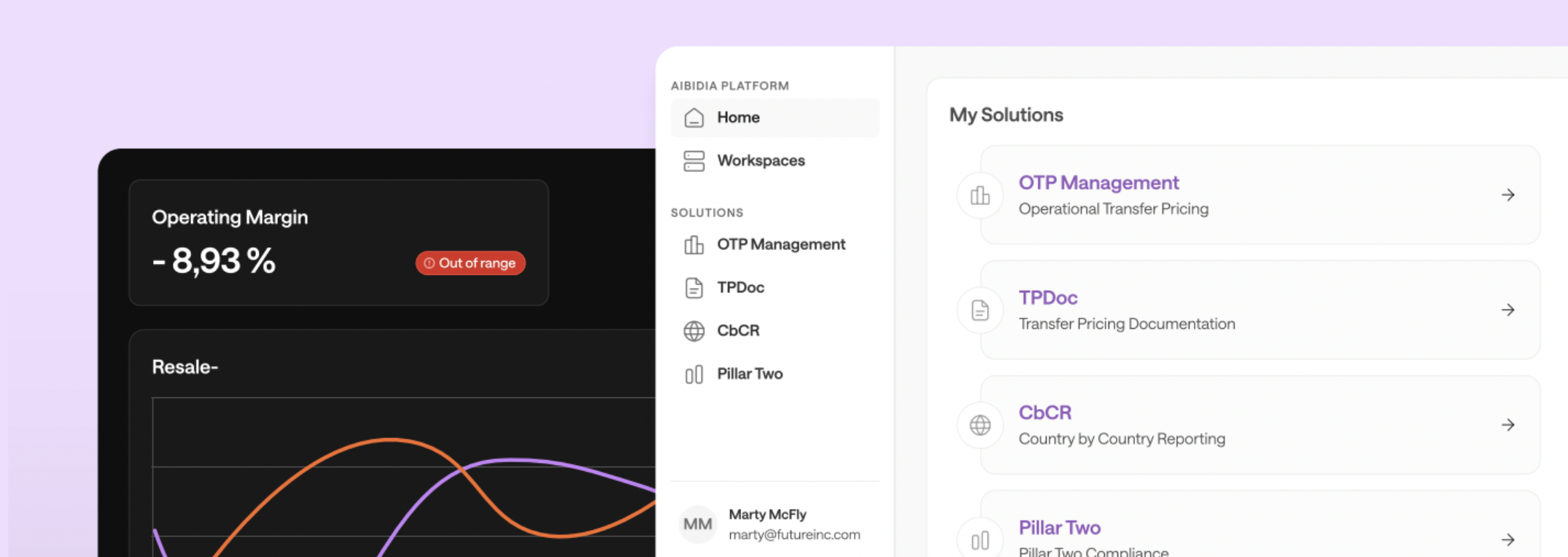
The alternative is to treat documentation as the output of maintained data rather than an annual writing exercise: entities, transactions, policies, financials, and functional analyses held in one structured place, with Master Files, Local Files, and the CbCR generated from that single source rather than drafted independently. This approach delivers three benefits that matter to both tax auditors and tax directors: consistency, because every Local File draws on the same underlying policy data as the Master File; efficiency, because year two starts from year one's data rather than a blank template; and audit readiness, because the documentation already reconciles with the CbCR and the financials before anyone asks for it. Aibidia's platform is built around this model, producing Master Files, Local Files, and the CbCR from a single data source rather than three separately maintained documents.
Common pitfalls
- Treating "TP documentation" as one obligation rather than several, with different legal bases. The US divergence above is the clearest example, but it is not the only one: some jurisdictions layer additional local forms, certifications, or transaction-level disclosures on top of the three-tiered approach.
- Assuming contemporaneous means "at the time of the transaction." It rarely does; it means documentation that is ready by a defined checkpoint, often the return filing date.
- Letting the Master File go stale while Local Files get updated. A group's structure and policies tend to change faster than its Master File narrative unless someone is responsible for keeping it current.
- Treating the CbCR as a compliance-only exercise now that it is tied to Pillar Two relief. Under the current transitional safe harbor, CbCR data quality has direct Pillar Two consequences, not just audit-risk ones.
- Conflating confidential CbCR with public CbCR. They share a EUR 750 million threshold (tested differently) and much of the same data, but serve different audiences under different rules and timelines.