COMING SOON

Aibidia Report 2026:
The State of Transfer Pricing

Aibidia's annual industry report explores how transfer pricing professionals are responding to rising audit scrutiny, operational complexity, fragmented data environments, and the growing role of AI. Join the waitlist to be first to know when it launches, or explore insights from the 2025 edition while you wait.

Download the 2025
Annual Report

Express interest to participate

Leave your email below and our team will follow up with next steps.

Why Join the Waitlist

0

Get it first

Be the first to receive the 2026 report the moment it publishes, before it's shared more broadly.

0

See where you stand

Compare your team's approach against how transfer pricing professionals worldwide are responding to rising audit scrutiny, operational complexity, and the growing role of AI.

0

Get practical insight

The report captures how transfer pricing professionals are working in practice, from audit readiness and operational maturity to data management and AI adoption.
Insights

What youʼll learn inside the Aibidia report 2025

The rising cost of tax scrutiny
01

The rising cost of tax scrutiny

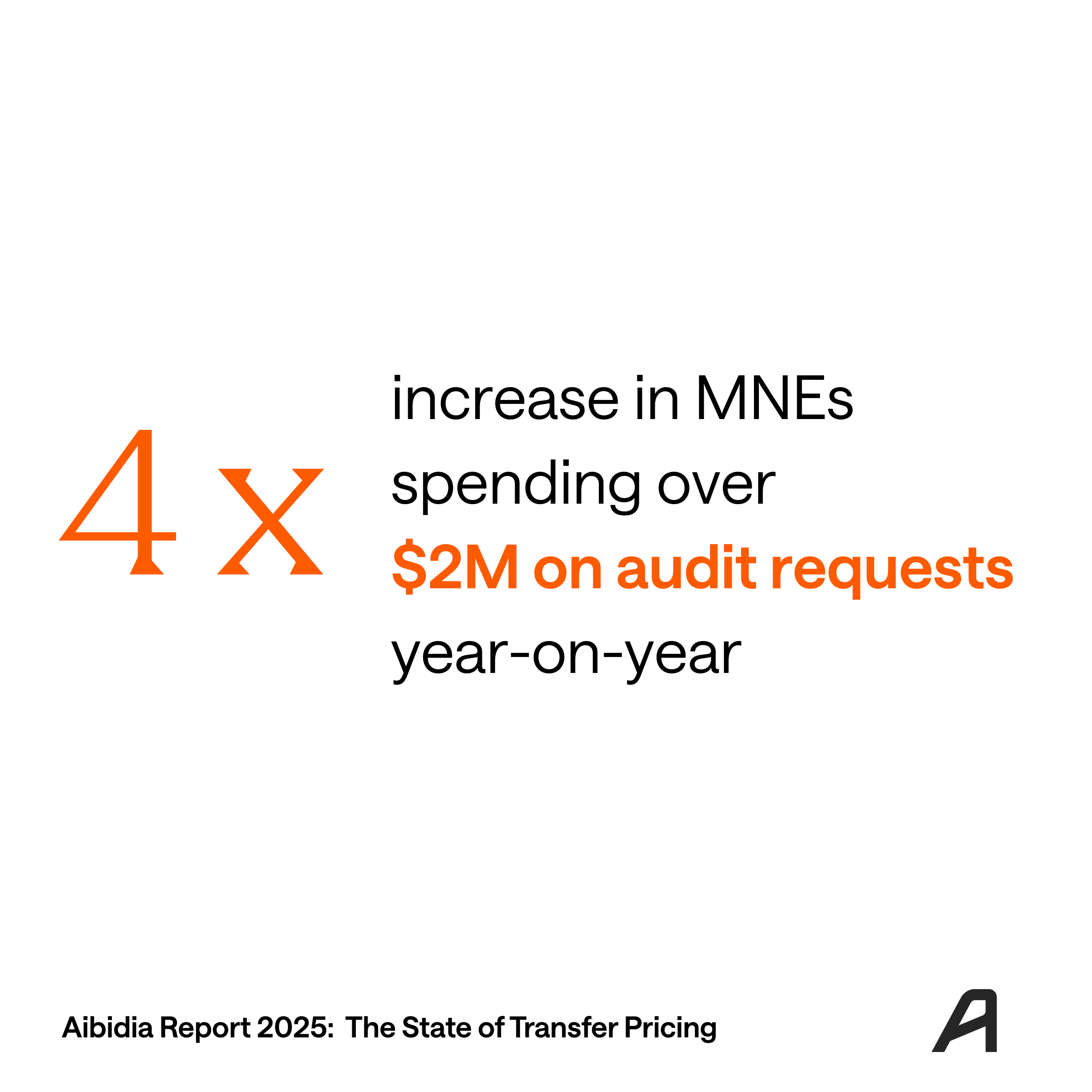
Heightened tax authority demands are driving up the time and money TP teams spend on audits. Companies with stronger documentation processes, centralised data, and proactive OTP practices are better positioned to contain both costs and risk.

02

The state of OTP maturity

Only 35% of companies have a well-defined OTP process, while 24% have none at all. Barriers to OTP maturity include poor data access, complex business models, and limited coordination between tax, finance, and IT.

03

The importance of structured data

With 72% of companies in fragmented data environments, the report shows how centralised data helps TP teams insource more processes, ensure consistent compliance, and handle audits more efficiently.

04

Technology and AI adoption in practice

42% of MNEs are investing in specialist software, reducing reliance on traditional tools. AI interest is steady rather than explosive, hinting that TP teams need clean, structured data before advanced analytics can add value.

Download the 2025 report

Submit the form below to access your report.

By submitting this form, I confirm that I have read the Privacy Policy and agree to the processing of my personal data by Aibidia for the stated purposes.
Thank you! The report will be sent to your inbox.

Expert insights

Structured, reliable data is essential for executing a consistent, defensible transfer pricing strategy. Common barriers to structured data include siloed legacy source systems, unclear data ownership, and inconsistent definitions across entities and functions.

Prasad Parwidala
Head of Professional Services, Aibidia
Read the case study

We see significant variation in OTP maturity across companies. In many cases, if existing processes appear to work, there’s less motivation to change. However, where we see this changing, is within MNEs that have faced increased scrutiny or operate with more complex structures.

Pia Honkala
Global Commercial Head - Operational Transfer Pricing, Aibidia
Read the case study

While there are many challenges in accessing the right data for TP calculations and analysis, one of the most significant barriers to OTP adoption can be the misalignment of KPIs between Finance and Tax teams.

Marlon Manto
Director, Transfer Pricing Advisory, Aibidia
Read the case study

We’re seeing practical AI adoption in areas such as navigating country-specific documentation requirements, researching transfer pricing methods, comparing jurisdictional rules, and tracking global compliance timelines.

Maria Helander
VP Product, Aibidia
Read the case study
INDUSTRY RESEARCH

Aibidia Report 2026:
The State of Transfer Pricing

138 professionals share how their transfer pricing functions operate today, from data sourcing and audit pressure to AI readiness.

Get the report
The State of Transfer Pricing
2026
FOREWORD

The next era of transfer pricing will connect the knowledge behind it.

Transfer pricing has always been complex. What is changing is the nature of that complexity.

For years, the challenge for multinational tax teams was largely one of compliance: setting appropriate policies, documenting them, and demonstrating that the organization had met its obligations.

That challenge has not disappeared. But it is being joined by something much bigger.

Hannu-Tapani Leppänen
CO-FOUNDER & CEO; AIBIDIA
Transfer pricing context is built across people, systems and decisions
The operating model shows up in everyday details.
THE CORE PROBLEM

Transfer pricing does not have an information shortage. It has a context problem.

Tax authorities have more data and far better analysis. Finance leaders expect unprecedented visibility. AI is raising expectations for speed across the board. Yet, the foundations of operational transfer pricing remain fragmented.

Get the report
44%
Handled 4 or more audits or inquiries in 24 months.
60%
Still use primarily manual Operational TP Management.
DATA SOURCING
Where does the data come from?
Only 14% draw data directly from a single ERP. The vast majority rely on a mosaic of systems, spreadsheets, and inconsistent extracts.
Combination of system and manual extracts27%
Multiple ERPs or source systems19%
Single ERP or consolidation system14%
Central warehouse or BI13%
Finance or shared-service reports10%
Manual spreadsheets10%
Undefined or inconsistent process7%
The Data Wrangling Tax
79% of teams spend more than 10% of their total transfer pricing time merely gathering and reconciling data.
1 to 10% 21%
11 to 25% 38%
26 to 49% 20%
50% 10%
51 to 74% 11%
THE BOTTLENECKS
Top operational transfer pricing challenges
Share of respondents ranking each in their top three obstacles.
Timely high-quality data82%
Coordination across Tax, Finance and IT68%
Insufficient automation or specialized technology62%
Complex models or transactions55%
Limited internal expertise or resources33%
Coordination is part of the operational challenge.
Better context makes decisions easier to explain.
OPERATIONAL MATURITY
State of processes in 2026
Partially structured
45%
Well-defined and managed
38%
No established process
16%
Not applicable
1%
THE AI SHIFT
Regular AI use rose from 18% in 2025 to 37% in 2026.
22%
Say their data is clean and structured enough for AI or LLM use without manual work.
75%
Expect a first documentation draft to be handled by AI in 2 to 3 years.
8%
Expect AI to touch strategic policy design.
What should the transfer pricing function look like when all of its knowledge can finally work together?
The future is connecting activities and context, not adding more isolated point solutions.
Learn more about the next generation of transfer pricing technology →
Access the
2026 findings.
Complete the form to instantly unlock the full PDF report. Discover how 138 of your peers are navigating the shift from information to intelligence.