
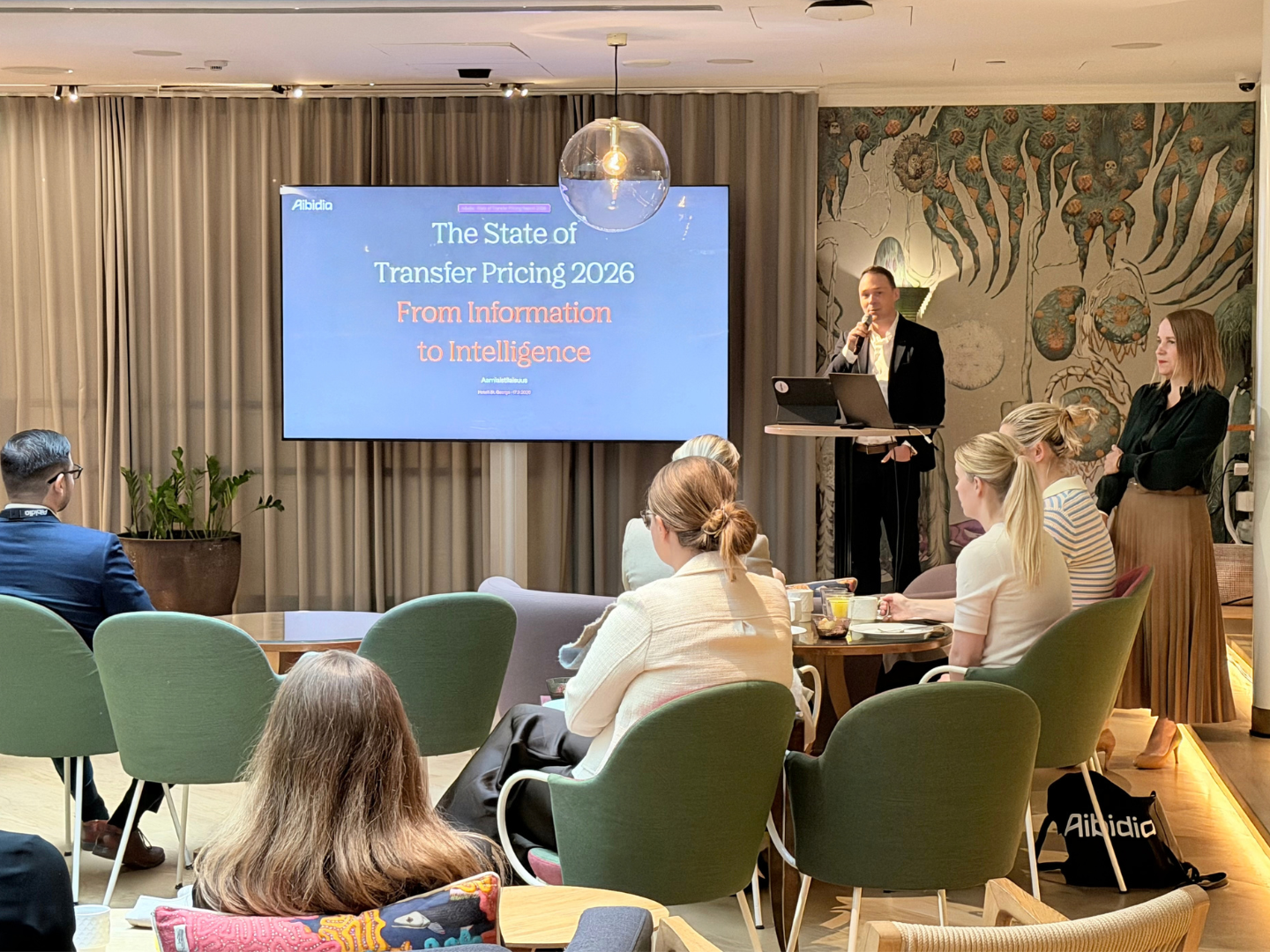
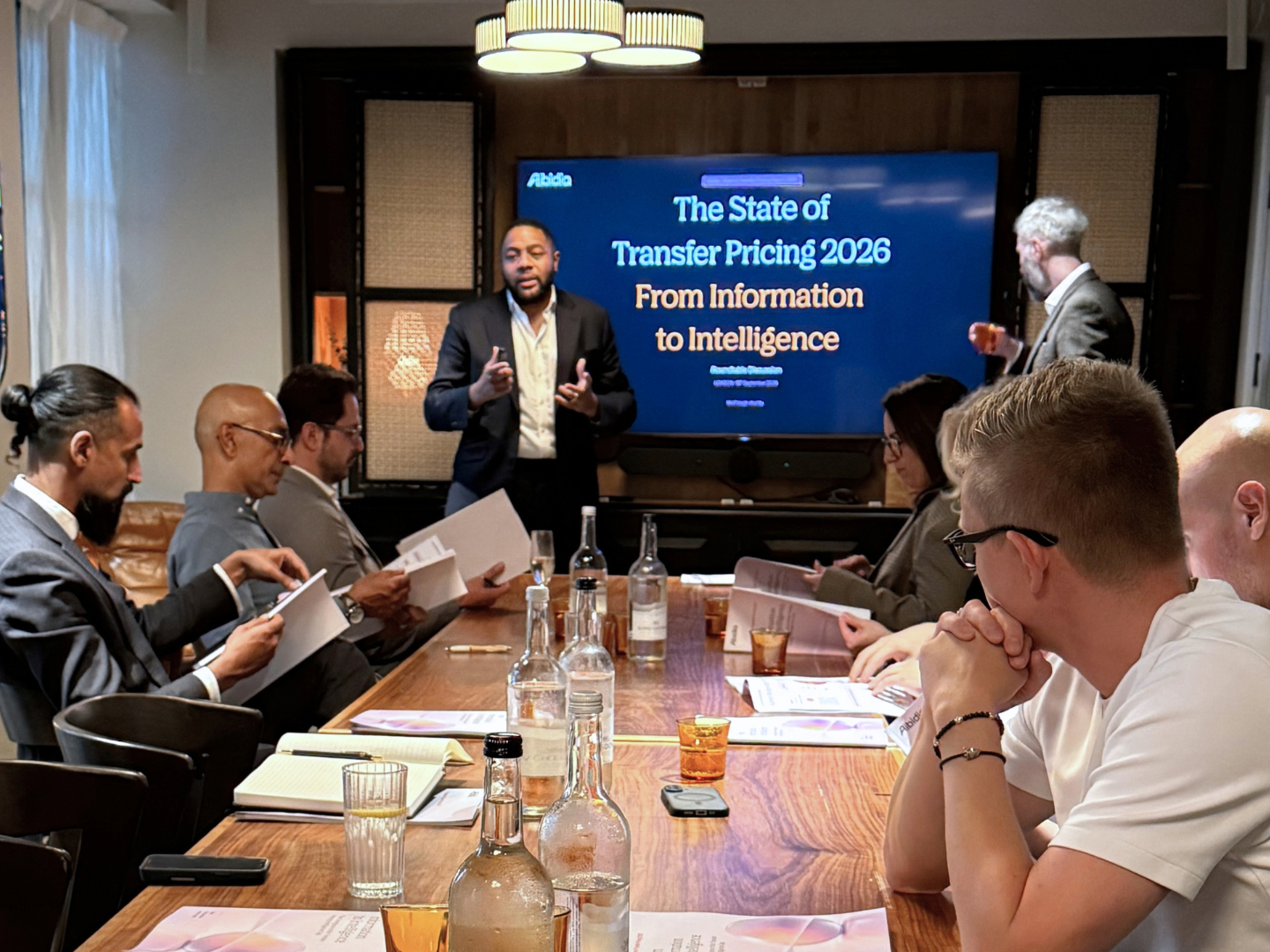
Aibidia recently gathered senior tax and transfer pricing professionals in London and Helsinki to compare the realities of running a modern TP function. The conversations converged on the same challenge. Transfer pricing teams are not short of information. They are short of connected context.
The discussions drew on the third annual Aibidia Report: The State of Transfer Pricing 2026 and brought its findings to life. Together, the research and practitioner perspectives reveal a function under pressure to manage greater complexity, respond faster and make better use of technology, often without the foundations required to do so.
Five main themes emerged:
1. TP teams are carrying growing complexity with limited resources
The research captured responses from 97 in-house tax professionals. More than four in five work for organizations with annual revenue above $1 billion, and 58% operate across more than 30 jurisdictions. Yet 63% have three or fewer dedicated TP professionals.
That imbalance is reshaping the operating model. Hybrid resourcing is now the most common approach: 53% combine substantial internal capability with external support, up from 38% in 2024. Fully outsourced models remain rare.
The London discussion suggested that this shift is about more than capacity. Several participants described a more selective use of external advisors, reserving them for jurisdiction-specific, highly technical or high-risk matters while bringing recurring documentation and compliance work in-house.
Participants also questioned the value of traditional advisory models when substantive work is increasingly offshored, automated or delegated to junior teams. In some cases, in-house professionals felt they were still doing much of the analysis, while paying advisors primarily for external validation and risk absorption.
The emerging model is therefore neither fully outsourced nor fully internal. It is one in which the organization retains ownership of its data, judgment and institutional knowledge, while buying specialist expertise where it clearly adds value.
2. Data wrangling remains one of the biggest barriers to progress
Data preparation remains one of the largest drains on TP capacity. Seventy-nine percent of respondents spend more than 10% of their team’s time sourcing, cleaning and formatting data; 21% spend at least half of their time on it. Nearly half operate across four or more ERP or financial reporting systems.
The event discussions made those figures tangible. Participants described reconciling general ledgers with consolidated financial data, resolving inconsistent account structures and waiting for local entities to provide information. The data often exists, but it is dispersed across systems, teams and formats.
This is not merely a systems problem. It is an operating-model problem.
Centralizing every activity is not necessarily the answer. Local controllers often hold the closest view of the underlying data and business reality. But involving them effectively requires shared definitions, clear ownership and an understanding of what and why the TP team needs.
That means improving the data foundation requires cooperation across tax, finance, controlling, IT and local business teams. Without that alignment, highly skilled TP professionals continue to spend their time reconstructing context instead of interpreting it.
3. The gap between TP policy and operational reality remains significant
Most organizations have a transfer pricing policy. Far fewer can continuously see whether the business is operating in line with it.
Only 38% of respondents describe their operational TP processes as well defined and managed. Sixty percent still rely primarily on Excel, email and other manual processes, while only 7% formally monitor transfer prices monthly. Half report moderately or very significant year-end adjustments.
Participants explained why the gap persists. Business conditions move faster than policies and processes. Acquisitions, new business lines, changing transaction flows and IP transfers may occur without the tax team becoming involved until much later.
Tax can set the policy, but execution crosses organizational boundaries. Controllers, finance teams and business leaders all influence the outcomes. TP professionals can identify risk and explain the consequences, but they do not always control the commercial decisions that create the exposure.
One participant described the ideal: a real-time view of margin performance against policy benchmarks, allowing the team to identify deviations, understand their financial impact and intervene before they become material year-end corrections.
That ambition captures the shift now required from periodically checking compliance to continuously understanding outcomes.
It also matters for audit readiness. In a volatile business environment, the absence of adjustments is not always reassuring; it may raise the question of whether the policy still reflects operational reality.

4. AI adoption is accelerating but integration is lagging
AI adoption has accelerated dramatically. The proportion of respondents reporting no AI use fell from 36% to 7% in one year, while regular use across TP processes more than doubled from 18% to 37%.
For now, however, most use remains task-based. Participants described using Microsoft Copilot, ChatGPT and Claude for:
- Drafting and reviewing documentation
- Research and idea development
- Formatting and summarizing data
- Stress-testing responses to tax authorities
These tools can improve individual productivity, but the discussions also exposed clear limits. Participants raised concerns about hallucinations, overconfident answers and the inability of general-purpose models to interpret company-specific TP data without sufficient context.
In transfer pricing, a plausible answer is not enough. A conclusion must be grounded in the relevant agreements, policies, transactions, financial data and regulatory framework—and it must be traceable to the evidence behind it.
This is where the readiness gap becomes visible. Ninety-three percent of respondents use AI in some form, but only 22% believe their TP data is structured and clean enough for AI to use without manual intervention. At the same time, majorities expect AI agents to gather and format data, monitor compliance and perform first-pass audit reviews within the next two to three years.
The next stage of adoption will therefore depend less on access to another model and more on the environment around it: connected data, domain-specific logic, clearly defined parameters, appropriate guardrails and traceability to source material.
5. Transfer pricing needs context, not more information
The clearest message from both events was that transfer pricing does not have an information shortage. It has a context problem.
Policies, agreements, benchmarks, financial results, documentation and audit history usually exist. But they often live in different systems and formats, with critical knowledge held by different people. Each source contains part of the answer; the team must manually connect them before it can understand what is happening, why it matters and what to do next.
This is the Transfer Pricing Intelligence Gap: the distance between having information and being able to turn it into timely, defensible action.
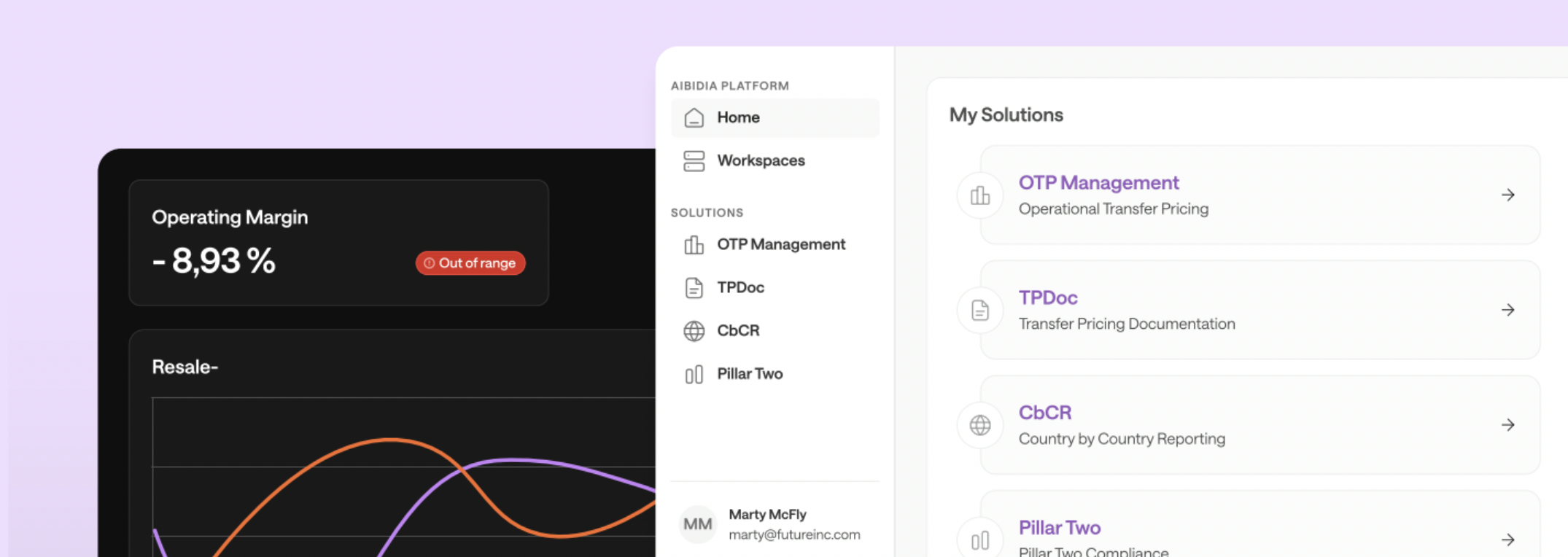
During the Helsinki briefing, Aibidia demonstrated a vision for closing that gap. By reading and structuring agreements, financial data, policies and benchmarks, an intelligent TP system can create a digital representation of an organization’s transfer pricing reality. That connected model can make transaction flows visible, identify inconsistencies, estimate the financial impact of potential risks and trace insights back to their original evidence.
In the demonstration, the system identified and quantified a potential €4.8 million risk in one entity, directed the user to the supporting agreement and proposed a possible course of action.
The significance was not the number itself. It was the ability to connect a risk to its business context, quantify its potential impact and preserve the evidence behind the conclusion.
That is the difference between storing information and creating intelligence.

The next era of transfer pricing
The goal is not autonomous AI making unsupported decisions. Nor is it simply faster documentation or another layer of automation.
The opportunity is to connect policy, operations, documentation and audit defense across the TP lifecycle so that teams can understand what is happening, identify what matters and act earlier.
For senior TP leaders, this raises a broader strategic question: where should the function build enduring internal understanding, and where should it rely on technology or external expertise?
The answer will vary by organization. But the direction is increasingly clear. The next era of transfer pricing will be defined not by who holds the most information, but by who can connect that information, reason across it and turn it into better decisions.
Explore the findings: From information to intelligence – The State of Transfer Pricing 2026
For senior transfer pricing leaders who want to help shape that future, the TP Intelligence VIP Program offers early access to product developments, exclusive research, digital roundtables and ongoing market insights.